
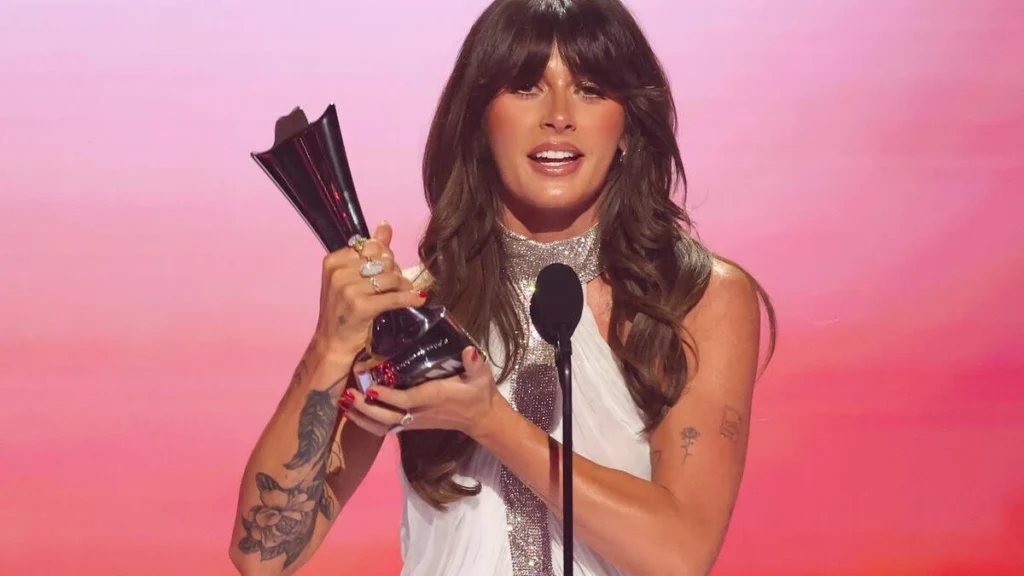
Ella Langley accepting the Academy of Country Music award for female artist of the year in May 2026.
The biggest single of 2026 belongs to a country artist most casual listeners had not heard of two years ago. Ella Langley’s Choosin’ Texas has now spent 14 weeks at No. 1 on the Billboard Hot 100, drawing level with two of the most durable chart records in pop history.
On the chart dated 25 July, the song matched Mariah Carey’s “We Belong Together” and Whitney Houston’s “I Will Always Love You” for the most weeks at No. 1 among non-holiday titles billed solely to women with no male-billed acts. For a discovery-minded listener, the interesting part is not the record itself. It is how quickly Langley got there.
The Record She Just Tied
“Choosin’ Texas” first reached No. 1 in February and has held or returned to the top ever since. Billboard’s chart-beat rundown places it in rare company on the all-time list of longest-leading Hot 100 hits billed solely to women, a list that dates back to August 1958:
- 22 weeks — “All I Want for Christmas Is You”, Mariah Carey (2019-26)
- 14 weeks — “Choosin’ Texas”, Ella Langley (2026)
- 14 weeks — “We Belong Together”, Mariah Carey (2005)
- 14 weeks — “I Will Always Love You”, Whitney Houston (1992-93)
- 13 weeks — “The Boy Is Mine”, Brandy & Monica (1998)
- 11 weeks — “Independent Women Part I”, Destiny’s Child (2000-01)
- 11 weeks — “Un-Break My Heart”, Toni Braxton (1996-97)
Counting Carey’s Christmas perennial, “Choosin’ Texas” now ties for the second-longest command of the chart by songs credited only to women. Along the way it has passed Brandy and Monica, Destiny’s Child and Toni Braxton.
The Numbers Behind Week 14
Long runs at No. 1 are usually held up by one metric while the others fade. This one is unusually balanced. For the tracking week of 10 to 16 July, the song logged 24 million official US streams, 51 million radio airplay audience impressions and 7,000 copies sold.
The direction of travel matters as much as the totals. Streams were down 4 per cent week over week while radio was up 1 per cent, which is the profile of a song that has moved from a streaming hit into a genuine radio standard without losing its on-demand base.
That balance is what makes a 14-week run possible. Songs that live purely on streaming tend to peak and fall; songs that cross into heavy radio rotation stay.
It is also why the record is harder to break now than it looks. The Hot 100 blends streaming, radio audience and sales into a single figure, so holding the top for a quarter of a year means winning on three different curves at once, each with its own decay rate. A song can lead on streams for a month; leading on all three inputs for fourteen weeks requires an audience that keeps choosing it after the novelty has gone.
Why Country Fans Were Not Surprised
Outside country, the run looks like an outlier. Inside it, Langley had been building toward this for a while. She took the Academy of Country Music’s female artist of the year award in May, and the single itself is a co-write with a serious room: Luke Dick, Miranda Lambert and Joybeth Taylor.
That writing credit is a useful tell for anyone tracking new artists. A breakout single with established co-writers attached usually signals an artist the industry had already identified, arriving at the moment the wider audience catches up.
The chart confirms the crossover in a way few records do. “Choosin’ Texas” became the first song by a female artist to lead the Hot 100, Hot Country Songs and Country Airplay charts at the same time, as Variety noted in its report on the run.
How a Country Single Held the Pop Chart
Country records reaching the Hot 100 summit is not new. Holding it is. The usual pattern is a fast debut driven by fan pre-saves and a first-week streaming spike, then a steep drop as pop and hip-hop releases reclaim the top tier.
“Choosin’ Texas” avoided that by not depending on any single format. Leading the Hot 100, Hot Country Songs and Country Airplay charts simultaneously means the song was the biggest record in its home genre and on general-market radio at the same moment, so a soft week in one lane was absorbed by strength in another.
For listeners who track where new music breaks, that is the signal worth noting. The song did not arrive through one platform’s algorithm; it built across country radio, streaming and sales together, which is the slower and more durable route.
What a 14-Week No. 1 Does to an Artist’s Career
A long No. 1 is not just a trophy. It resets everything downstream.
Catalogue discovery accelerates, because listeners who arrive through one song rarely stop at one song. Touring economics change, because a genuine hit moves an artist up a venue tier. Sync and brand interest follows radio saturation. And the next release goes out to an audience that already knows the name, which is the single hardest thing for a developing artist to buy.
The risk on the other side is equally real. An artist defined by one enormous single has to prove the second one, and country’s history is full of acts who spent a decade answering a song rather than building on it.
Who Else Is Breaking Through Right Now
The same chart week carried two more names worth following. Stella Lefty, described by Variety as a fast-rising country star, landed her first Hot 100 top 10 with “Boston” climbing to No. 6. British singer Olivia Dean topped the Radio Songs chart with “So Easy (To Fall in Love)”, moving from No. 12 to No. 9 on the Hot 100 and passing her own “Man I Need”, which slipped from No. 5 to No. 10.
Dean’s run is the more unusual statistic. Both songs have peaked at No. 5 on the Hot 100 and have now spent 41 and 46 weeks on the chart respectively, which is the kind of slow, sustained climb that streaming-era charts rarely reward.
Together with Langley, the picture is of a chart where longevity is beating novelty. Songs are taking longer to peak and staying far longer once they get there.
That shift changes how discovery works. When a hit takes forty weeks to reach its peak rather than debuting there, the window to find an artist early is far wider than it used to be. Listeners who followed Olivia Dean through her first chart run have had most of a year with her catalogue before the radio audience arrived, and the same was true of Langley before February. The chart is now a lagging indicator of what attentive listeners already knew.
What to Watch Next
The obvious question is whether Ella Langley’s Choosin’ Texas can reach a 15th week and stand alone above Carey and Houston among non-holiday titles by women. With streams easing slightly and radio still climbing, it is genuinely close.
The more useful question for anyone hunting the next favourite artist is what Langley does with the platform. A country record that holds the pop chart for a quarter of a year is not an accident of playlisting, and the follow-up will tell listeners whether they have found an artist or a moment. For a look at another act converting a breakout into a live career, see how Tyler Childers is redefining the modern arena tour.
This article was AI-assisted and edited for accuracy.
About The Author