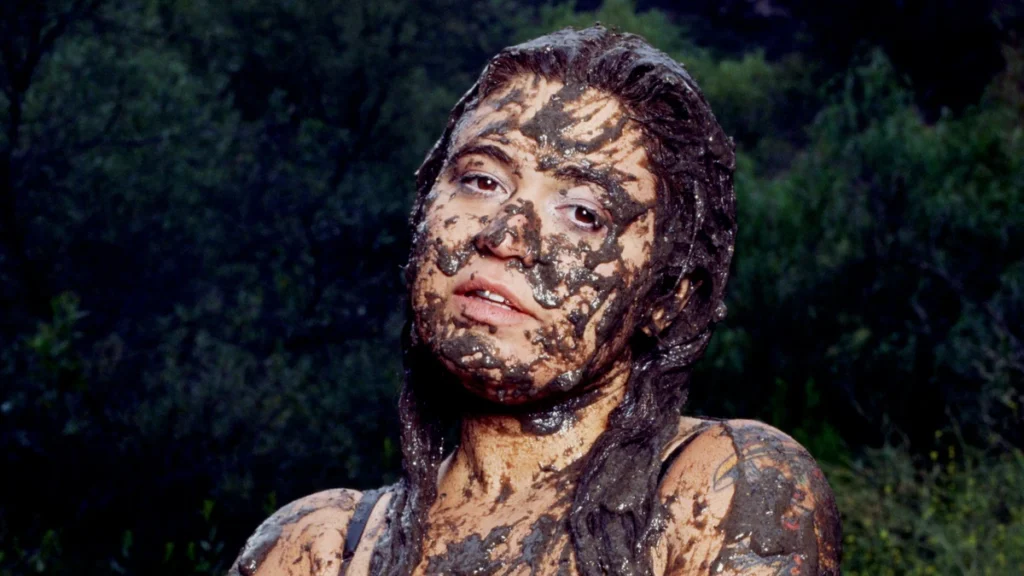
Press play on Mud and the first thing listeners will notice is how much has been taken away. The bright synths and stacked funk-pop arrangements that made Remi Wolf’s name are mostly gone. In their place are guitars, a band playing together in one room and slower, plainer songs. Released on 9 October through Island Records, Mud is Remi Wolf’s third album, and it is the one where she deliberately turned the volume down.
It is also a record built from an unusually large pile of material. Wolf wrote more than 100 songs while making it, and eleven made the final tracklist. What follows is a guide to how Mud was made, what it is about, the songs to hear first and the tour that takes it on the road in 2027.
A Deliberate Turn Toward Less
Wolf has been open about the change of direction. According to Complex’s guide to the album, she wanted a more minimalist record with very little synth, and set herself a simple test: every song had to work on an acoustic guitar around a campfire and still land with the listener. The band recorded together in the same room, and Wolf played drums on parts of the record herself.
That is a big shift from her first two albums, Juno in 2021 and Big Ideas in 2024, which leaned into colour, density and genre-hopping. Reviewing Mud for NME, Hollie Geraghty described a sound that has “toned-down, leaving rough and earthy textures”, built from “tempered electro-snap beats, soft ’80s-style riffs and echoey vocals”. For listeners who knew Wolf from her louder singles, it is a different first impression. For anyone new to her, it is a gentler way in.
Big Bear, Electric Lady and Joshua Tree
The album was made across three locations. Early sessions with her core collaborators took place in Big Bear, California, recording continued at Electric Lady Studios in New York, and the final sessions happened in Joshua Tree. Wolf co-produced the three advance singles with Jared Solomon, who records as Solomonophonic, and Jack DeMeo, with Jamie McLaughlin and Gigi Grombacher, Wolf’s sister-in-law, among the circle Complex describes as her “family band”.
The Joshua Tree sessions produced the album’s best-known guest spot. Wolf wrote “Moon So High” there, decided it needed to be a duet and sent John Mayer a direct message asking him to sing on it. He did, and the song sits seventh on the record, a slow guitar ballad.
The album was trailed by three singles: “Twiggy” on 31 July, “Bottle” on 20 August and “I Won’t Cry” on 25 September. “Twiggy” came with a video featuring Wallows drummer Cole Preston, and Wolf later performed it at Newport Folk Festival with Hayley Williams joining her on stage.
What the Record Is About
Mud was written in the aftermath of a hard stretch. NME’s review lists the circumstances: Wolf turned 30, ended a two-and-a-half-year relationship, struggled with sobriety and felt drained by years of touring. She got sober again shortly before writing most of the album, and she has named “Bottle”, “Champagne” and “Wine Drunk” as songs about being done with drinking.
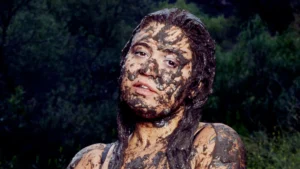
The title came from one song. Once “Covered In Mud” was written, Wolf knew what the album would be called, and the cover image followed the same idea: Wolf smiling while coated in mud, inspired by a photograph of a mud-covered child grinning at the camera. The point is cleansing rather than mess. In the Associated Press review, Elise Ryan described the result as “dirty and imperfect but renewed”.
Wolf has described the process as freeing. “I felt this permission to be honest and be my raw self,” she said. That honesty is what most reviewers responded to, even those who found parts of the record uneven.
The Songs to Hear First
“I Won’t Cry” is the obvious starting point. It was written and recorded in about three hours during the early Big Bear sessions, and the AP review describes “a ballad sung over a consistent drum beat, keys and the faint buzz of a turntable”, with vocals that are “raw, yearning, broken”. NME suggested it “should really come with a trigger warning for anyone nursing a broken heart”. The video, co-directed by Wolf and Milo Nichols, is set in a car wash.
“Wine Drunk” is the upbeat counterweight. The AP called it a peak of the album, built on “tongue-twister, rhyming lyrics”, while NME heard a “stomp-clap, power pop flirtation”. “Bottle”, the second single, is one of the rawest songs on the record: NME called it “breathtaking” and pointed to its “raw melancholy” as Wolf confronts the pull of alcohol.
“Moon So High” with John Mayer showcases what NME called Wolf’s “softest country lilt”, and the AP noted it recalls Mayer’s own guitar-ballad style. “Covered In Mud”, the title song in all but name, is a “simmering indie-rock crasher” in NME’s words, and “Yellow Rose” closes the album on what the same review called a “stirring” note.
The Middle of the Record
Between the singles, Mud moves through several styles, and this is where the album’s range shows most clearly. “Twiggy”, the first single, is a song about wanting someone who is emotionally unavailable, and NME picked out a line aimed squarely at that kind of lover. It was the song chosen to introduce the album in July.
“Burn Me Blue” pulls in a different direction. NME heard Wolf moving between the country-rock balladry of Shania Twain and the soaring rasp of Hayley Williams within the same song, a reminder that the plainer arrangements have not narrowed her voice. “Jamie” is the oddest moment: the AP described its spoken introduction as “delivered as if she was perched on a wooden stool in a jazz bar leaning toward the audience”, before the song builds into a bigger vocal finish.
“Guess” is where, in the AP’s words, Wolf “retreats into a folk sensibility”, and it is a clear example of the campfire test she set herself: a song that would work with one guitar and nothing else. Not every reviewer thought it worked in sequence, but on its own it shows the songwriting stripped to its frame. “Champagne”, one of the three songs about drinking, sits near the start of the record and was the one the AP suggested skipping.
Heard in order, those songs explain the album’s shape. The singles carry the emotional weight, and the middle stretch is where the record covers its widest range of styles, from country balladry to a jazz-bar spoken intro to bare folk.
Where the Critics Split
The reception has been positive but not uncritical. The AP gave the album four stars out of five, singled out “I Won’t Cry” and “Wine Drunk”, and listed “Champagne” as the track to skip. NME was warm about the album’s best moments but felt the “bluesy sing-speak-to-belting crescendo gamble” of “Jamie” did not quite land, and that the “fingerpicking repetition” of “Guess” stalls the record before its closer.
Both reviews agree on the main point: Mud trades the maximalism Wolf was known for in favour of something plainer and more personal. Listeners who loved the old sound may need a couple of plays. Those who come for the songwriting will find plenty to hold on to.
The Mud Tour Starts in February
Wolf marked the release with album shows in Los Angeles on 10 October and New York the following day, and has announced a North American run for early 2027. According to JamBase, the Mud Tour opens on 23 February at The Anthem in Washington, D.C. and closes on 22 May at WAMU Theater in Seattle, with stops across the US and Canada in between. Emma Ogier and Annabelle Dinda support on select dates. General on-sale is Friday 16 October at 10am local time.
How an artist tours a changed record is its own decision. GetMusic.News recently covered a different approach, when Steve Lacy chose to play his new album front to back before the hits. For Remi Wolf, the Mud Tour will show whether a quieter record can carry the same energy as the louder shows that built her audience.
About The Author