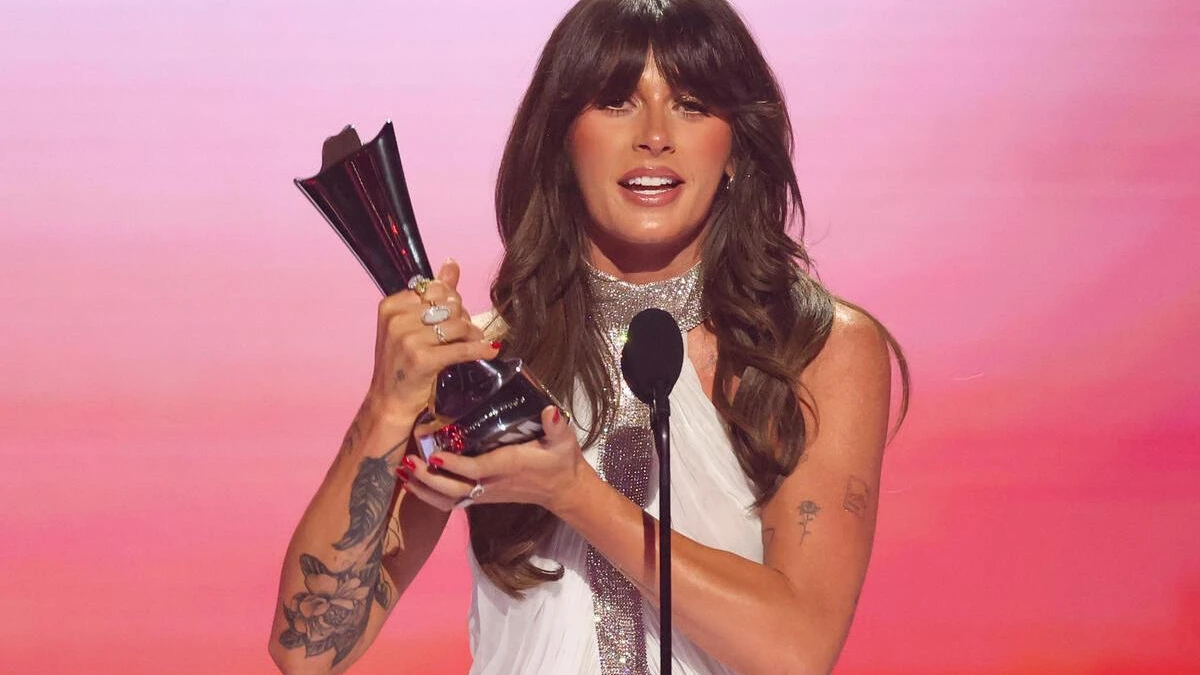

Ravyn Lenae released her third album Blue Island on 7 August.
Ravyn Lenae Blue Island landed on 7 August through Atlantic, and the first thing to say about it is that it is not really an R&B record any more. Her third album keeps the voice that made her name and swaps almost everything around it.
For anyone who found her through “Love Me Not” and the run that followed, this is the moment the story changes shape. The reviews are already circling the same question: whether a singer this good at one thing should be spending an album proving she can do six others.
From R&B Tinge to Pop Tidal Wave
NME’s Sara Delgado put the shift in the plainest terms. Lenae “took a pop-tinged R&B approach on 2022’s Hypnos and 2024’s Bird’s Eye,” she wrote, “but on album three Blue Island, that tinge lends way to a pop tidal wave.”
The genre list bears that out. Across the record there is ’00s indie rock, ’80s new wave, electro-funk, synthpop, dance pop and Jersey bounce, plus a Bollywood-inspired opener. Lenae has cited Santigold, Janet Jackson, Tracy Chapman, Blondie, The Sundays, The Cranberries and the electronic musician Martin Rev as reference points, which is a spread most artists would use across a career rather than one album.
That is a deliberate risk. R&B had her positioned as a reliable centre of gravity; pop asks her to compete in a far more crowded room.
What the Reviews Agree On
NME scored it 4.5 out of 5, calling it “a fully idiosyncratic album that proves Lenae is blazing through a new path” and praising the way she “fuses a retro flair with modern sensibilities.” Delgado’s favourite quality is structural: “chameleonic tracks that transform halfway through” are, she argues, “the album’s strongest points: catchy and toeing the line between familiar melodies and unexpected twists.”
Writing for The New Feminist, the verdict was similarly warm: “an engaging and progressive body of work” from an artist “redefining the boundaries of R&B through an innovative blend of genres.”
Both reviews land on the same underlying point. The experiment is not decoration. The songs are actually built differently.
Where They Split
The Line of Best Fit is more measured, scoring it 7 out of 10. Marie Hascoët credits “refreshing sonic experimentation” and picks out the funky productions, the rock moments and the Bollywood inflections, but flags the cost of casting the net so wide: the “nods can at times get overbearing,” she writes, describing the result as “a collage of 80s, 90s and 2010s highlights.”
That is the honest tension in Blue Island. A record assembled from this many reference points risks reading as a tour of influences rather than a position of its own. Hascoët still concludes the experimentation is “refreshing enough” to carry it, which is praise with a hand on the brake.
It is worth noting how few reviews exist so far. On a release-day record, three or four verdicts is a thin sample, and the consensus could move in either direction over the next fortnight.
The Tracks Doing the Work
“Handle” opens the album and sets the terms immediately: guitar-driven, New Wave in posture, Bollywood in its melodic detail. It arrived as a single in late May and was the clearest early signal that the record was not going to sit still.
“Saturday Night,” out in June, is the pop centrepiece, an electrofunk-leaning synthpop track built on shimmering synths and a refusal: “Say you miss me on a Saturday night / But I’m still leaving without you.” “Potential” pushes further into dance pop and Jersey bounce. “Find It One Day” pulls back toward 90s R&B, and “Let Us In” closes the record on what one reviewer called a bombastic note and another called chaotic, which is probably the same observation.
“Reputation,” the duet with Dominic Fike that shared lead-single duty with “Bobby” back in April, gets singled out for its writing rather than its production. The New Feminist rated it the album’s strongest lyric, and reserved a personal favourite for “Barriers,” a stripped-back, sensual outlier on a busy record.
The Reggae Thread and the Family Tape
Underneath the genre-hopping runs something more personal. Lenae is of Panamanian descent, and a reggae influence surfaces across “Familiar Dreams,” “Never Let Me Go” and “Bobby,” which reads less like another borrowed style than like the one thread on the record that is actually hers by inheritance.
“Never Let Me Go” also interpolates Chuck Jackson’s “Love Of You” and closes on a recorded family phone call. On an album accused in places of being a collage, that is the moment where the collage has a person standing behind it. It is the kind of detail that tends to survive after the production choices date.
The stated themes match: joy, anxiety, loneliness, heartbreak and the identity questions that arrive when a breakout single suddenly makes a career public.
Why This Matters if You Are Still Discovering Her
Context helps here. Lenae went into release week with roughly 30.7 million Spotify listeners, which puts her among the larger names on a crowded New Music Friday rather than in the true-discovery bracket. That scale is the point: she is big enough that a genre pivot costs her something real if it fails, and not so big that the label could stop her attempting it.
There is a familiar arc where an artist breaks through on one sound, spends album three consolidating it, and becomes predictable by album four. Blue Island is the opposite move, made at the exact point where consolidating would have been the safer commercial choice.
That makes it a better entry point than it looks. A listener arriving now gets the full range rather than a single lane, and the reviews suggest the range is real rather than cosmetic. It is the same pattern that turns a buzz act into a long career, visible here in real time, much like the bedroom-studio-to-arena jump we tracked earlier this summer.
The counter-argument is fair too. If you came for the R&B, a pop tidal wave is not what you asked for, and “Find It One Day” is the only track the reviews describe as reaching back toward it.
What Comes Next
Lenae is set to play London’s All Points East, which will be the first real test of whether this material scales to a festival field. Records this dense with ideas can thin out in the open air, and the chameleonic structures NME praised are exactly the sort of thing that needs a good sound engineer to land.
The longer question is what the pop turn does to her audience. Bird’s Eye built a following on precision and restraint. Ravyn Lenae Blue Island asks that following to come along somewhere louder and stranger, and it does so on day one rather than easing them in.
On the evidence of the first reviews, most of them should. A 4.5, a 7 and a warm unscored notice is a good opening week for a record designed to unsettle expectations, and it puts Ravyn Lenae Blue Island in the small category of third albums that are more interesting than the breakthrough that preceded them.
This article was AI-assisted and edited for accuracy.